
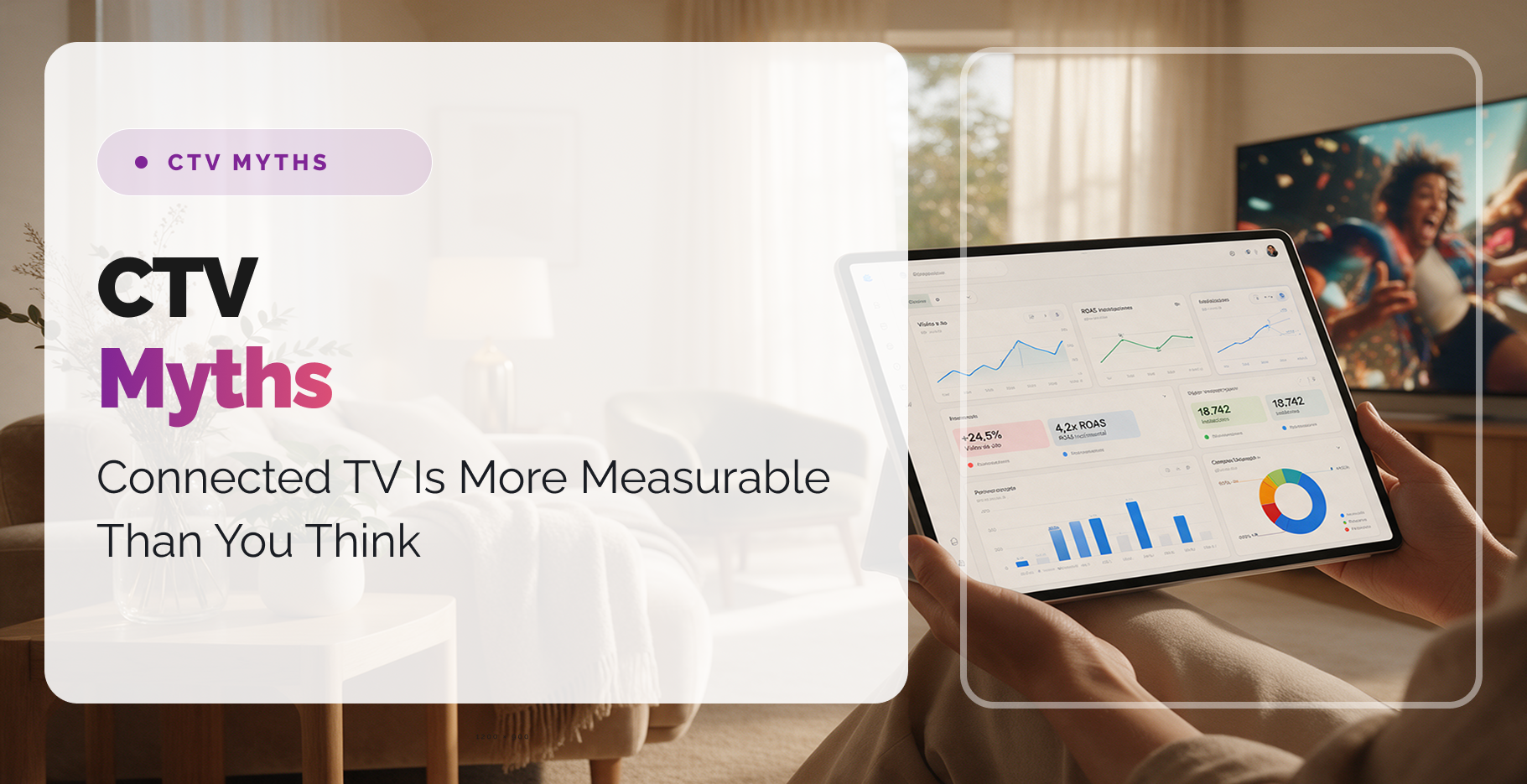
Connected TV can feel harder to measure than other digital channels. Because there’s no click, some advertisers still see CTV as difficult to connect to performance.
But Connected TV is not a black box. With the right measurement approach, advertisers can understand whether their campaigns are reaching the right households, influencing digital behavior, and ultimately contributing to outcomes like site visits, installs, in-app activity, and downstream performance.
When it comes to CTV, the better question for advertisers to ask is: Are we measuring it the right way?
CTV Measurement Looks Different
CTV does not always follow the same path as mobile UA, search, or social. A viewer may see an ad on TV, then take action later on a phone, laptop, or tablet. That can make measurement more complex, but it does not make it impossible.
The important point is that CTV measurement needs to match actual viewer behavior. Viewers do not always act in the same moment they see an ad, but with the right setup, advertisers can effectively evaluate the impact of that exposure.
Seedtag notes that CTV measurement helps advertisers understand who saw an ad, how often they were exposed, and what they did afterward. That includes signals like website visits, on-site engagement, lead generation, and broader brand impact.
What Advertisers Can Measure
CTV measurement is strongest when it connects delivery to outcomes. Instead of stopping at impressions, advertisers should evaluate whether the campaign reached the right audience and contributed to meaningful outcomes.
Advertisers can measure:
- Reach and frequency: Who saw the ad and how often they were exposed.
- Engagement signals: Site visits, app activity, time on site, or other actions after exposure.
- Conversions: Installs, purchases, signups, or other campaign goals.
- Incremental impact: Whether CTV added reach or outcomes beyond what other channels would have driven.
Incremental impact is especially important for advertisers adding CTV to an existing media mix. The question is not just whether CTV received credit for a conversion. It is whether CTV created value that would not have happened otherwise.
Measured analyzed 274 incrementality experiments across 60 enterprise brands and found that CTV drove incremental revenue. The analysis also found that CTV delivered a higher median incremental ROAS than Meta and Google, despite receiving a much smaller share of total media budgets.
Because CTV often works alongside other performance channels, the goal is to understand whether it reached new audiences, influenced later actions, and strengthened the overall media mix.
Measurement Depends on the Setup
CTV measurement starts with defining success before the campaign starts. If the goal is awareness, advertisers should prioritize reach and frequency. If the goal is performance, they should evaluate post-exposure signals like site visits, app activity, conversions, or incremental lift. The metric should match the campaign objective.
The attribution setup matters, too. Advertisers should set VTA windows thoughtfully and confirm whether qualified CTV views receive equal attribution priority during that window, so that exposure is not automatically deprioritized in favor of click-based channels.
The goal is not to give CTV credit for everything. The goal is to understand the role CTV played in influencing behavior and contributing to measurable outcomes.
The Bottom Line
The myth is that CTV is too hard to measure. It is not, but it does require the right setup.
In CTV, strong measurement depends on more than confirming whether an ad was delivered. It requires the right goals, tracking, attribution windows, and measurement partners to understand whether the campaign reached the right audience, influenced behavior, and contributed to meaningful business outcomes.
CTV measurement may look different from other digital channels, but with the right setup, it gives advertisers actionable insight into campaign performance.
Want to learn more about common CTV myths? Watch for the next installment in this blog series.